Benefits of Trademark Search
Conducting a thorough trademark search before filing your application is crucial for protecting your brand and avoiding costly legal complications.
Brand Protection
Secure your brand identity and prevent unauthorized use of your trademark by competitors.
Avoid Legal Issues
Identify potential conflicts early and avoid costly legal disputes down the road.
Faster Registration
Streamline your trademark registration process with comprehensive search results.
Build Brand Value
Establish a strong brand foundation and increase your business market value.
How to Conduct Trademark Search
Follow our streamlined 4-step process to conduct a comprehensive trademark search and protect your brand effectively.
Enter Your Trademark
Type your desired trademark name or phrase into our advanced search tool.
AI-Powered Analysis
Our system searches through millions of registered trademarks and identifies potential conflicts.
Review Results
Get detailed reports on similar trademarks, their status, and potential conflict levels.
Expert Consultation
Connect with our trademark experts to get personalized guidance on next steps.
Why Choose Trademarx.in for Trademark Search
Join thousands of businesses who trust Trademarx.in for their trademark search and registration needs.
Comprehensive Database
Access to 2+ million trademark records updated in real-time.
Lightning Fast
Get instant search results powered by advanced algorithms.
Expert Support
Backed by a team of experienced trademark attorneys.
Real-Time Trademark Updates
We update the latest trademarks every hour to keep you ahead.
How to Do a Trademark Check Online the Right Way
Choosing a brand name is one of the most important decisions for any business. But before you invest in a logo, website, packaging, or marketing, there is one critical step that most people ignore — trademark search.
A proper trademark check online ensures that your business name is legally safe and does not conflict with any existing trademarks. Skipping this step can lead to rejection, legal issues, or even complete rebranding after launch.
In this detailed guide, you will learn:
- How to perform a brand name registration check in India
- How to use trademark search IP India tools
- What mistakes to avoid during trademark search
- How to check phonetic similarity (the most ignored factor)
- And how to use advanced tools like our platform for accurate results
What is a Trademark Search and Why is it Important?
A trademark search is the process of checking whether your desired business name, logo, or brand identity is already registered or applied for by someone else.
When you perform a trademark check online, you are essentially verifying:
- Whether your name is unique
- Whether similar names already exist
- Whether your name can be legally protected
This step is crucial because trademark registration in India follows a first-come-first-serve basis. If someone else has already applied for a similar name, your application may face objections or rejection.
This is why understanding how to check if a brand name is already registered in India online is essential before filing.
Types of Trademark Searches You Must Perform
Most people think trademark search is just typing a name into a database. In reality, a proper trademark search IP process involves multiple layers.
1. Exact Match Search
Exact match search is the most basic type of brand name registration check, where you search for the exact name you intend to use. For example, if you search for “Zomato” and an identical name already exists in the same trademark class, your application is likely to face objections or rejection. However, relying only on an exact match search is not sufficient, as trademark conflicts can also arise from similar or phonetically matching names.
2. Phonetic Search (Most Important)
Phonetic search is the most important type of trademark search because trademark law places strong emphasis on how a name sounds, not just how it is spelled. For instance, names like “Zomato” and “Zomatto” or “QuickKart” and “KwikCart” may appear different visually but are considered similar due to their pronunciation, which can lead to objections during the registration process. This is a common area where many applicants fail when performing a trademark check online in India, as they overlook phonetic similarity while evaluating availability.
3. Class-Based Search
Class-based search is an essential part of the trademark registration process, as trademarks in India are categorized into different classes based on the type of goods or services they represent. For example, Class 25 covers clothing, Class 30 includes food products, and Class 35 relates to business services. Conducting a proper trademark search class-wise ensures that your brand name is evaluated within the correct category, reducing the risk of conflicts and improving the chances of successful registration.
How to Do a Trademark Check Online in India (Step-by-Step)
Step 1: Define Your Brand Name Clearly
Decide the exact spelling and variations of your brand name.
Also consider:
- Alternate spellings
- Short forms
- Sound variations
Step 2: Perform a Basic Trademark Search
You can start with the government database (IP India), but it has limitations:
- Complex interface
- Limited phonetic accuracy
- Time-consuming
Step 3: Use an Advanced Trademark Search Tool
To simplify the process and get more accurate results, you can use our trademark search tool which is specifically designed to:
- Perform advanced trademark check online
- Detect phonetic similarities
- Show risk level of your brand name
- Help you avoid rejection before filing
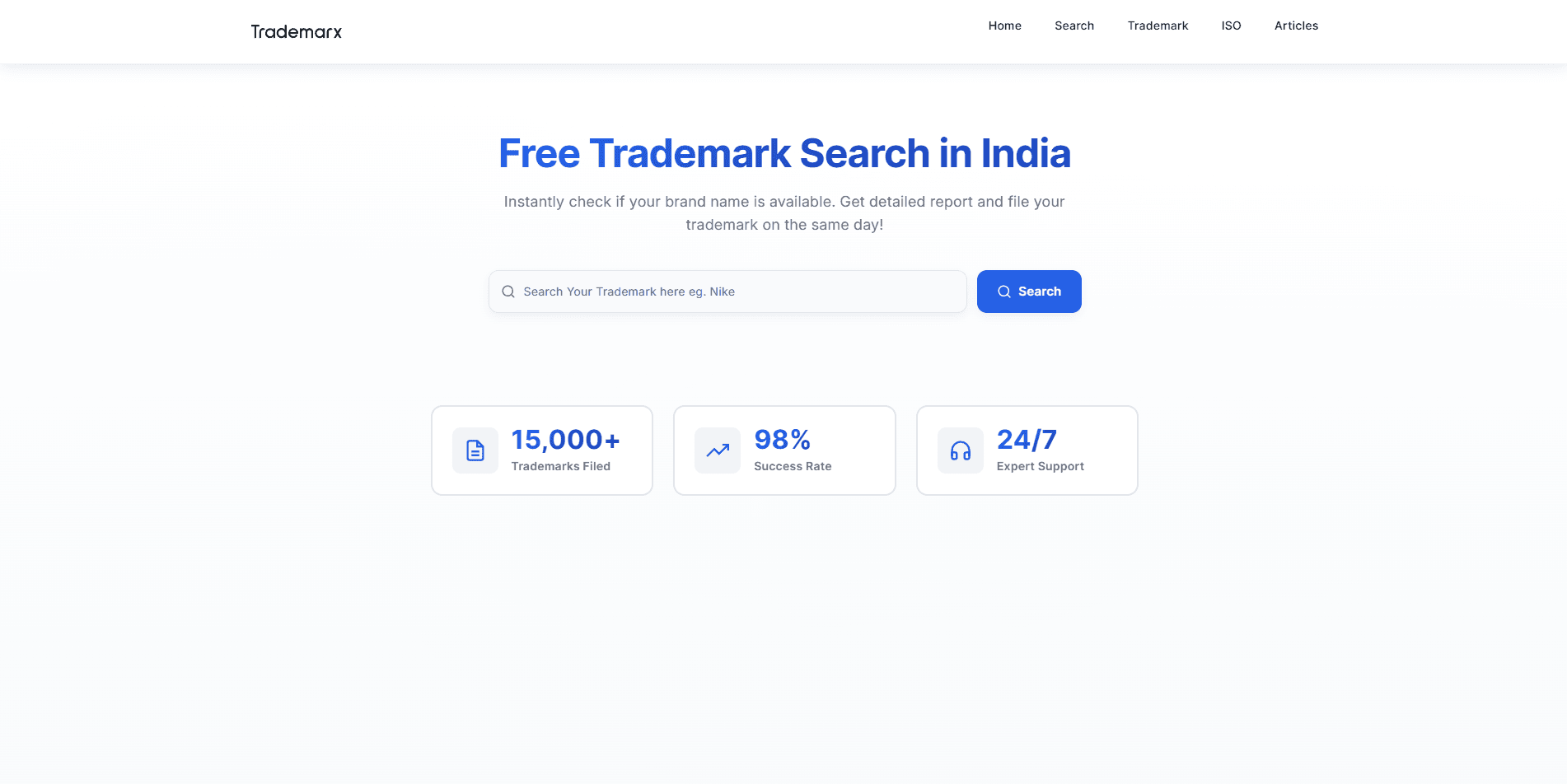
This directly solves the problem of
“how to do a proper brand name registration check with phonetic matching”
Step 4: Analyze the Results
While doing a trademark search IP, look for:
- Identical names
- Similar sounding names
- Same class conflicts
If you find conflicts, it does not always mean rejection — but it increases risk.
Common Mistakes People Make During Trademark Search
1. Relying Only on Google
Many people think: “Google pe naam available hai = trademark safe hai”
This is completely wrong.
Google does not show:
- Registered trademarks
- Pending applications
- Phonetic similarities
2. Ignoring Phonetic Matches
This is the biggest mistake.
Even if your spelling is different, your application can still be objected if the pronunciation is similar.
3. Not Checking the Correct Class
A wrong class means:
- Weak protection
- Possible conflicts later
4. Skipping Professional or Advanced Tools
Manual searches often miss:
- Similar sounding brands
- Slight variations
This leads to objections after filing.
How to Check if a Brand Name is Already Taken (Practical Approach)
If you want a reliable method for brand name registration check in India, follow this:
- Search exact name
- Search phonetic variations
- Check multiple classes
- Use an advanced tool
- Evaluate risk level
This approach ensures that your trademark check online India is accurate and complete.
What Happens If You Skip Trademark Search?
Skipping a proper trademark search IP India can lead to:
- Trademark objection
- Application rejection
- Legal notices
- Brand confusion in market
- Complete rebranding cost
Many businesses realize this only after investing heavily in branding and marketing.
Advanced Tip: Choose a Trademark-Friendly Name
To increase approval chances:
- Avoid generic words (e.g., “Best Shoes”)
- Avoid descriptive names (e.g., “Quick Loans”)
- Prefer unique or invented names (e.g., “Zomato”)
- Keep it short and distinctive
This directly improves your success rate in trademark check online and registration approval.
Why Use Trademarx for Trademark Search?
Our platform is built specifically to solve the problems faced during traditional searches.
👉 Try here: https://trademarx.in/search
With Trademarx, you can:
- Perform fast and accurate trademark check online
- Get phonetic similarity results
- Avoid costly mistakes before filing
- Make smarter branding decisions
Conclusion
A proper trademark search is not optional — it is the foundation of your brand’s legal safety.
Whether you are a startup, small business, or established company, doing a detailed:
- Trademark check online
- Brand name registration check
- Trademark search IP India
can save you from rejection, legal issues, and financial loss.
Before you invest in your brand, invest a few minutes in the right search.
Check Your Trademark Now
Don’t take risks with your brand name.
👉 Visit: https://trademarx.in/search
Run a free trademark check online and ensure your business name is safe before filing.
Trademark Search India
Frequently Asked Questions
Everything you need to know before searching and filing your trademark in India.
Registered — fully protected; the owner has exclusive rights.
Pending / Filed — submitted but not yet examined. May still become a conflict.
Objected — the Examiner has raised concerns; the applicant must respond.
Advertised — passed examination, published for a 4-month public opposition window.
Opposed — a third party has filed a challenge against registration.
Refused / Abandoned — the application failed.
Even Pending and Advertised marks can block your application — never ignore them in your search results.
1. Modify the name — add a distinctive word, change spelling, or pair it with a unique logo.
2. Check the mark's status — if it is Abandoned or Refused, you may be able to apply for the same name.
3. Conduct a prior-use investigation — if the existing mark has not been commercially used, a prior-use claim may be possible.
4. Negotiate a co-existence agreement with the existing owner.
5. Consider filing in a different class if your goods or services can be legitimately classified elsewhere.
Our trademark experts can assess your specific situation and recommend the best path forward after your search.
• Filing — Day 1, application number issued immediately.
• Examination — 6–12 months for the Registry to review.
• Response to objection (if raised) — 2–3 months to respond.
• Advertisement — published in the Trademark Journal after approval.
• Opposition period — 4 months for third parties to challenge.
• Registration certificate — issued after the opposition period closes.
Filing under the expedited route (at higher fees) can reduce examination time to approximately 1–3 months.
• Phonetic and fuzzy matching — the government portal does not offer this.
• Class-wise conflict scoring — highest-risk results are highlighted first.
• Faster, cleaner interface — no Java requirement or browser compatibility issues.
• Expert review in 10 minutes — our attorneys review your results and flag non-obvious conflicts.
We recommend using Trademarx for your primary search, then corroborating on the IP India portal before filing.
1. Applicant details — full legal name and address (individual, LLP, or company).
2. The trademark — word, logo, or combination. Logos must be in JPG format, 8×8 cm.
3. Description of goods/services and the relevant trademark class(es).
4. Date of first use in commerce, if claiming prior use.
5. Power of Attorney (Form TM-48) if filing through an attorney — highly recommended.
6. MSME or Startup India certificate, if applicable, to claim the concessional fee of ₹4,500 instead of ₹9,000 per class.
Trademarx can prepare and file all documents on the same day as your search.
Start Your Trademark Search Now
Join 15,000+ businesses who have successfully registered their trademarks with Trademarx.in
Choose the Right Plan for Your Trademark Journey
Select a plan that fits your needs — from quick application filing to complete end-to-end trademark protection.
- Trademark Application Filing
- Support via Call, Chat & Email
- Trademark Certificate
- Regular follow-ups until Published in Journal
- Continuous application status updates
- Reply to Examination Report
- Handling of Hearings
- Free Business Website
- Trademark Application Filing
- Support via Call, Chat & Email
- Trademark Certificate
- Regular follow-ups until Published in Journal
- Continuous application status updates
- Free Business Website
- Reply to Examination Report
- Handling of Hearings
- Trademark Application Filing
- Support via Call, Chat & Email
- Trademark Certificate
- Regular follow-ups until Published in Journal
- Continuous application status updates
- Reply to Examination Report
- Handling of Hearings
- Free Business Website